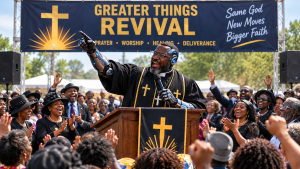
During an interview at the National Association of Black Journalists convention, former president Donald Trump claimed that “immigrants are taking Black jobs!”
Shortly after that, memes and videos of Black Americans on their “Black Jobs” or just presenting the irony of what Trump asserted with humor started appearing on TikTok, Facebook, X, Instagram, and LinkedIn. So, it begs the question, especially given that Labor Day has just been recognized…What are Black jobs?
In the United States, Black employment history is a complex and evolving story. According to the World History Encyclopedia, there are six periods in this country’s existence: early history, post-Emancipation, the Great Depression, World War II, the Civil Rights Movement, and the Modern Era.
 Early History. The expansion of chattel slavery in North America was driven by the labor demands of white Americans living on farms and plantations in the South. White slaveholders exploited African and African American enslaved persons to boost agricultural production and increase their wealth. During the 17th century, Virginia enslaved workers were forced to plant and harvest tobacco. Later in the 17th and 18th centuries, enslaved persons in South Carolina and Georgia worked on large rice plantations. In the 19th century, cotton became king, which meant enslaved persons worked extensively on cotton plantations that spread westward from the eastern seaboard states through Alabama, Mississippi, Louisiana, and Texas.
Post-Emancipation. Following emancipation, former African American enslaved persons found challenges in navigating a complex job market. However, systemic racism placed barriers to them gaining independence through land ownership and managing farms. Given the vulnerabilities imposed on these individuals, many participated in exploitative labor arrangements such as sharecropping and tenant farming—working for white landlords in exchange for crops; industrial and domestic work such as working on railroads, mining, cooking, cleaning, and childcare; and convict leasing—performing hard labor in mines, railroads, and plantations after being arrested on questionable charges.
 The Great Depression. Many of the “Black jobs” post-Emancipation carried over into the Great Depression. However, President Franklin Roosevelt introduced New Deal programs. African Americans participated in public works projects through agencies like the Works Progress Administration (WPA) and the Civilian Conservation Corps (CCC), which offered employment opportunities in construction, infrastructure, and conservation projects. The roots of civil rights advancements and activism were established during this period.
World War II. Despite the onslaught of discrimination and segregation, African Americans were present in the military—often assigned to labor and service units and in construction roles. Some even served in combat roles, such as the Tuskegee Airmen—an all-Black squadron of fighter pilots. On the home front, many African Americans were employed in war-related industries or public works and administration roles. African American women—known as the Black Rosies—worked in shipyards, factories, and administrative offices. No matter where African American men and women worked, they continued to work against racial and gender discrimination.
The Civil Rights Movement. During this era, the number of African Americans in government offices and professional and skilled trades, such as teachers, doctors, nurses, lawyers, and skilled craftsmen, increased. However, many became involved in the NAACP and CORE and advocated for social change. Their involvement paved the way for future advancements in employment and civil rights.
The Modern Era. Despite the ongoing reality of systemic racism in the employment system, African Americans are continuing to excel in the following: healthcare and social assistance, public administration, education, transportation and warehousing, retail and service industries, professional and technical service, and entrepreneurship. However, diversity, inclusion, and equity (DEI) roles have quickly disappeared three years since the murder of George Floyd, and Black workers could become even more vulnerable to systemic racism in organizations.
 African Americans have historically proven wherever their “Black jobs” take them, they are a critical and impactful part of the workforce. Even if there is a shift from DEI to the new acronym – Environmental, Social, and Governance Strategy (ESG), African Americans can bring their “Black job” talents to any organization. Forbes magazine also noted that after Trump made that ignorant statement, “Using #BlackJob and #BlackJobs on social media, many physicians, judges, attorneys, accountants, pilots, engineers, and others are making clear that there is Black representation across roles and industries; (and) several are posting photos of themselves in their workplace settings.”
We got this!