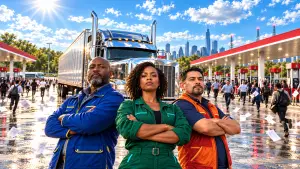
Employment unions are in for a bumpy ride under the Trump administration. Just recently, a federal judge cleared the way for the Trump administration to proceed with the mass firing of federal workers despite the National Treasury Employees’ Union trying to stop it.
While unions have received a bad rap over the years for hindering flexibility in the workplace, limiting management’s ability to make decisions, and sometimes prioritizing seniority over individual performance, union bosses will now have to stand up more than ever to help people keep their jobs. Ironically, the president’s focus has changed from improving the economy to likely firing many of the people who voted for him.
 Before we dive into unions nationwide, we want to bring our reader’s attention to one of the first Black union efforts made up of Pullman porters – which is a central theme of Black History Month this year – remember the month we are not supposed to celebrate in many of our workplaces despite its American History.
 According to the Jim Crow Museum, after the Civil War, Chicago businessman George Pullman began hiring thousands of African American men, including many former slaves, to serve white passengers traveling across the country on his company’s luxury sleeping cars. The Pullman porters greeted white passengers, carried luggage, served food and drinks, cleaned cars, and made up beds. While the passengers basked in luxury and service, the Pullman porters were often underpaid, overworked, and faced racism and discrimination on the job. They often worked long days, sometimes away from their families for weeks.
By the 1920s, a little over 20,000 African Americans worked as Pullman porters and train personnel, the largest category of Black labor in the United States and Canada at the time. Pullman porters helped fuel the Great Migration and shaped the Black middle class. To improve their working conditions, they formed the Brotherhood of Sleeping Car Porters (BSCP).  In 1937, after 12 years of resistance and negotiations, the BSCP was recognized as the official union of the Pullman porters or the first African-American labor union to sign a collective bargaining agreement with a major corporation. Their victory helped to lay the foundation for the united efforts of Black workers and labor unions during the Civil Rights movement.
Pullman porters, according to the Jim Crow Museum, had an alliance with several prominent Black newspapers from 1914 to 1939: the Baltimore Afro-American, Chicago Defender, New York Age, New York Amsterdam News, and Pittsburgh Courier and The Western Appeal, which became the official publication of the United Brotherhood of Railway Porters. Its editor, Roy Wilkins, worked with A. Philip Randolph, leader of the Brotherhood of Sleeping Car Porters, and Arnold Aronson, leader of the National Jewish Community Relations Advisory Council, to form the Leadership Conference on Civil Rights.
Even San Antonio has a history with the Pullman porters. In 1983, Dr. John Worsham donated the Pullman Sleeper Car McKeever to the Texas Transportation Museum in San Antonio. The McKeever, built by the Pullman Company and entering service in 1924, was regularly used for service between San Antonio and New York. It transferred from the Missouri, Kansas, and Texas to the New York Central in St. Louis. During its daytime configuration, the McKeever could seat 55 people and had 27 sleeping beds.
As transportation evolved, the number of Pullman porters declined in the 1960s due to decreased passenger travel and the discontinuation of sleeping car service. Additionally, over the years, unions have struggled with membership.
According to the Minnesota Reformer, union membership recently slipped to a record, single-digit low of 9.9% nationally, only a hair down from 10% in 2023. Four decades ago, the union membership rate was twice what it is today: Roughly 20% of the American workforce were union members in 1983. Other data show union membership was as high as 33% in 1945.
While company execs may spin unions are bad, the Economic Policy Institute’s data shows otherwise. They said that, on average, the 17 U.S. states with the highest union membership have state minimum wages that are 19% higher than the national average and 40% higher than those in low-union-membership states. Also, their data shows union members have median annual incomes of $6,000 higher than the national average. The Institute also said unions help reduce gender and racial/ethnic wage gaps. Hourly wages for women represented by a union are 4.7% higher on average than for nonunionized women.
 So while behemoths like Amazon are quick to fire labor organizers like Chris Smalls, who staged an Amazon walk-out for better working conditions, company executives are still getting rich and making profits soar for their shareholders. At the same time, the worker bees fight to survive.
Change will only happen if we learn the lessons of our past, whether from the Pullman porters, the Memphis sanitation workers strike in 1968 that Martin Luther King, Jr. supported, or the modern-day Chris Smalls. The fight against inequity is still ongoing, but it’s not just happening to Black people. It’s time for others to step up.